 By
·
10 minute read
By
·
10 minute read
Over the last two decades, network engineering has evolved from manual, device-by-device CLI commands to more sophisticated, intent-based and API-driven automation. Yet, despite this progress, most network operations still rely on human-triggered workflows and static, predefined logic. Your engineers write the scripts, your tools execute the playbooks, and your controllers push the configurations, but the core intelligence remains external to the network itself.
That is about to change, though not in the way most people think.
The question on every network engineer's mind is often some variation of, "Will AI replace me?" That is the wrong question. The real shift happening now is how AI in network automation is transforming the approach from reactive scripting to proactive, cognitive reasoning. We are moving from tools that simply execute what we are told to do, to intelligent systems that can understand what we want to achieve and continuously reason about the best way to deliver it.
Table of contents
- The Evolution of Network Engineering: Five Generations of Intelligence
- From Automation to Autonomy: The GenAI Leap
- The Role of LLMs and RAG in Network Operations: Grounding AI with Your Network's Data
- Examples of Generative AI used in network configuration and management
- Integrating AI Agents with Cisco and Multi-Vendor Ecosystems
- The Human-in-the-Loop Future: How Engineers and AI Co-Create
- Skills and Workforce Transformation: The Path Forward
- Implementation Challenges (and how to avoid them)
- Ethical Considerations: Building Networks That Can Be Trusted
- The Road Ahead: Networks That Think, Learn, and Collaborate
Recent industry data shows we are in the early stages of a fundamental architectural shift. Ready to see what happens when your network stops following scripts and starts thinking for itself? Let's dig in.
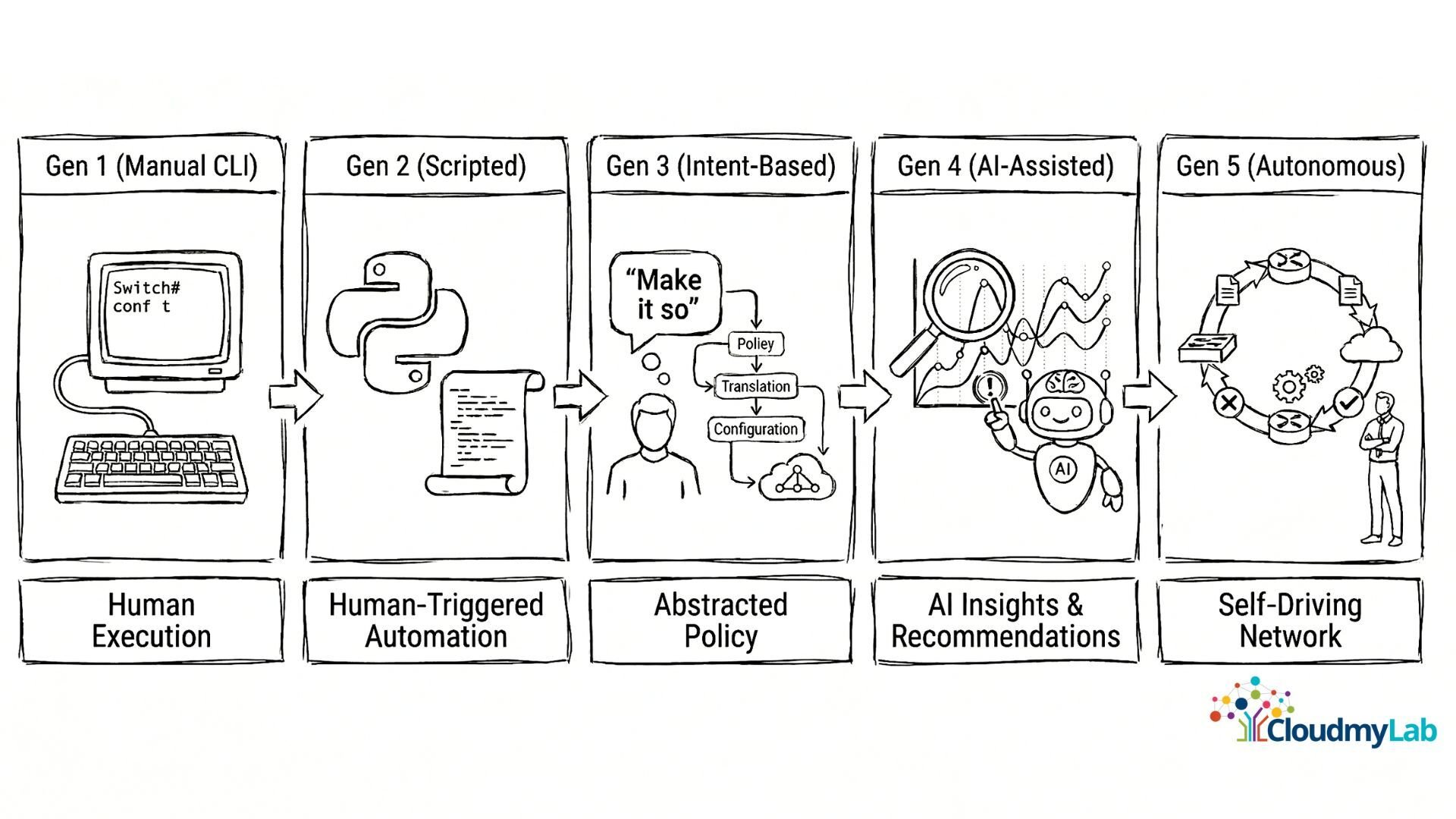
The Evolution of Network Engineering: Five Generations of Intelligence
Let me show you how we got here and where we're heading:
- Gen 1: Manual CLI (The stone age we all started in) Remember typing the same VLAN configs on 50 switches? Copy, paste, pray you didn't fat-finger an IP. This is where most of us cut our teeth. Pure human execution.
- Gen 2: Scripted automation (Where most of us live today) Python scripts, Ansible playbooks, maybe some Terraform. You've automated the repetitive stuff, but you're still the brain. The scripts just execute faster than your fingers.
- Gen 3: Intent-based networking (The promise that never quite delivered) "Just tell the network what you want!" they said. In practice? You're still writing policies, just at a higher abstraction level. The intent engine is sophisticated, but it's not intelligent.
- Gen 4: AI-assisted operations (Landing in production now) Here's where things get interesting. I've been testing systems that can look at your network telemetry and actually tell you "Hey, that latency spike correlates with CRC errors on this specific interface. Probably a bad cable." Not because someone programmed that specific scenario, but because the AI learned the pattern.
- Gen 5: Autonomous networks (The near future) Networks that detect issues, diagnose root causes, and fix problems without waking you up. Not science fiction. Early versions are running in production at major enterprises today.
The leap from Gen 3 to Gen 4 is bigger than it looks. We're moving from systems that execute logic to systems that can actually reason.
From Automation to Autonomy: The GenAI Leap
Traditional network automation is designed to answer the question, “How do I execute this specific task?” Generative AI, on the other hand, is designed to answer a much more complex question: “What is the best course of action to take right now and why?”
Large Language Models (LLMs) and Agentic AI systems can interpret natural language, analyze vast amounts of unstructured telemetry data, and orchestrate complex, multi-step workflows across various APIs and systems. Imagine a network copilot that not only executes a configuration change you request but also simulates its impact, validates its compliance with your security policies, and automatically documents the entire change for you.
This transition marks the rise of cognitive automation. Systems that don’t just do what they’re told, but also learn and decide based on the context of the situation and the high-level goals you have defined.
Network Automation vs. Autonomous Networks
| Aspect | Network Automation | Autonomous Networks |
|---|---|---|
| Decision Model | Rule-based, with predefined logic (if this, then that). | AI/ML-driven, with adaptive learning and pattern recognition. |
| Scope | Focused on specific, well-defined, and bounded tasks. | Focused on holistic, end-to-end system optimization. |
| Learning | Static. Rules only change when updated. | Dynamic. Continuously learns from experience. |
| Handling Novel Situations | Fails or requires human intervention when it encounters a scenario that is outside its scripted logic. | Can reason through unfamiliar problems by applying patterns learned from historical data. |
| Human Intervention | Frequent (to initiate tasks, handle exceptions, and update rules). | Exceptional only (for high-risk decisions or novel problems that require strategic input). |
| Example | "If a BGP session is down, trigger a failover script." | "Detect BGP anomalies, diagnose the root cause, validate the potential impact of a change, and recommend (or execute) a validated intervention." |
Traditional network automation is powerful for routine, repetitive tasks. An automation script can handle 10,000 different scenarios if someone has taken the time to program all 10,000 of them. But it will inevitably fail when it encounters scenario 10,001.
Autonomous networks are designed to handle scenario 10,001 because they don't just follow pre-scripted logic. They can reason through new problems by applying patterns learned from vast amounts of historical data.
What are Autonomous Networks?
Autonomous networks are self-managing infrastructures that use artificial intelligence to automatically optimize their own configuration, detect anomalies in real-time, and resolve issues without requiring human intervention for routine decisions. They continuously learn from operational data (telemetry, logs, incident reports) and adapt their behavior to achieve your high-level business intent.
This is more than just "fancy automation." The underlying architecture is different. Instead of static rules determining behavior, machine learning models observe complex patterns in your network's telemetry, identify subtle deviations from a healthy baseline, and generate context-aware, intelligent responses.
The Role of LLMs and RAG in Network Operations: Grounding AI with Your Network's Data
Large Language Models are pattern-matching machines trained on the entire internet. Powerful? Yes. But also prone to making stuff up. Ask an LLM about your network and it might confidently describe configurations that don't exist.
That's where RAG (Retrieval-Augmented Generation) saves the day. Instead of letting the AI freestyle, RAG grounds it in your actual network data.
Here's how it works in practice. Your engineer types: "Why are users in the Seattle office complaining about Teams quality?"
Without RAG, the AI gives generic advice about QoS and bandwidth. With RAG, it:
- Pulls real telemetry from your Seattle office circuits
- Checks your actual QoS configs
- Reviews recent change logs
- Analyzes historical patterns from similar incidents
Then responds: "I found packet loss on the MPLS circuit (GigE0/1) starting at 2:47 PM, correlating with the Teams complaints. Your QoS policy is correctly configured but the circuit is hitting 94% utilization during video calls. Three options: upgrade bandwidth, implement more aggressive traffic shaping, or move Teams to the backup internet circuit."
That's not generic advice. That's specific analysis of your actual network.
Examples of Generative AI networking
Autonomous Troubleshooting
Today, your engineer sees an alert, logs into multiple devices, checks logs and docs, tries to find the root cause, and then implements a fix.
With an agentic approach, an AI agent ingests syslogs, SNMP traps, streaming telemetry, and NetFlow data all at once. It correlates signals across different domains i.e. linking a spike in application latency to a specific fabric leaf switch or a misaligned QoS policy, all in seconds. It then proposes a validated fix with a clear confidence score. The real-world result?
Your Mean Time To Resolution (MTTR) can drop from hours to minutes. More importantly, rare or new failures that might have stumped even senior engineers for days can be handled intelligently and quickly.
AI in Network Change Management and Validation
Today, your engineer plans a change, a peer review checks for obvious mistakes, and the change is deployed during a maintenance window. If something breaks, hours are spent troubleshooting and rolling back.
With an agentic approach, before deployment, an AI agent simulates the proposed change in a digital twin of your network. It checks the change against your security and compliance policies, looks for potential SLA conflicts, identifies any security implications, and automatically generates a detailed rollback procedure. By the time a human is asked for approval, 90% of the risk assessment is already done.
The real-world result? Your change control process shifts from a reactive review to a proactive risk assessment, your deployment confidence goes up, and your change-related outages go down.
Intelligent Documentation and Knowledge Extraction
Every network has "tribal knowledge" buried in old emails, outdated runbooks, vendor support cases, and the notebooks of senior engineers. This critical knowledge disappears as people leave.
With an agentic approach, GenAI systems can pull out, summarize, and organize this unstructured data into a dynamic, searchable knowledge base. A new engineer on your team can ask a question like, "How did we fix the BGP route leak that happened in Q1 of last year?" The system can then give them a complete summary with relevant config diffs, root cause analysis, and post-mortem notes.
The real-world result? Your valuable institutional knowledge becomes accessible and searchable. Your new engineers get up to speed much faster, and recurring problems get solved more quickly.
Closed-Loop Assurance Systems
Today, your monitoring system sends an alert when an SLA is violated. Someone on your team sees the alert and acts on it.
With an agentic approach, AI agents can continuously monitor for SLA compliance, detect when the network's intent has drifted from its actual configuration, find the root cause, and autonomously trigger a fix. These intelligent feedback loops mean your network can self-correct before problems become visible to users.
The real-world result is a network that can heal and optimize itself without needing manual intervention for routine issues, dramatically improving your SLA compliance and overall network reliability.
Integrating AI Agents with Cisco and Multi-Vendor Ecosystems
Modern enterprise networks have a mix of technologies from Cisco ACI, Catalyst Center, NSO, and Meraki, to platforms like Arista CloudVision and Juniper Mist. Agentic AI systems are designed to act as meta-orchestrators, talking to these diverse platforms through their APIs and SDKs to unify visibility and action across your entire multi-vendor setup.
Cisco’s AI-native operations initiatives and ACI’s policy-driven fabric are well-aligned with this vision. When you pair these powerful platforms with Generative AI, they can evolve from simple controllers to true collaborators. They will be able to engage in dialogue, reason about complex problems, and perform adaptive actions across your multi-vendor infrastructure.
The Human-in-the-Loop Future: How Engineers and AI Co-Create
"Will AI replace network engineers?" Wrong question. Autonomous does not mean humanless.
Network engineers will shift from being executors of commands to curators of intent and supervisors of intelligence.
In this model, AI agents propose actions; engineers validate them.
The synergy between human expertise and AI reasoning yields a co-creative operational model which is fast, safe, and adaptive.
Skills and Workforce Transformation: The Path Forward
Here's what network engineers actually need to understand: The role isn't disappearing. It's multiplying and specializing.
What new skills will network engineers need in the GenAI era?
The skill set for a Generation 5 network engineer will include:
- Prompt engineering and LLM orchestration: Communicating intent to AI systems and validating AI-generated outputs.
- Intermediate Python programming: Essential for API and data manipulation.
- APIs, data pipelines, and LLM toolchains: Integrating GenAI systems with network infrastructure.
- AI observability and explainability: Understanding why an AI system makes a recommendation and monitoring its performance.
- Cross-domain systems thinking: A holistic understanding of how networking intersects with DevOps, SecOps, and AIOps.
Implementation Challenges (and how to avoid them)
Let's be honest about what breaks when you deploy AI in production:
The data quality nightmare
Your AI is only as smart as your data. Most networks have garbage telemetry. Inconsistent logging, missing SNMP metrics, incomplete flow data. I've seen AI systems train on bad data and make consistently wrong decisions.
Fix: Start with a data audit. Clean up your logging standards. Normalize your metrics. Yes, it's boring. No, you can't skip it.
Legacy gear that won't play nice
That critical distribution switch from 2008? It doesn't have APIs. Your AI can't manage what it can't talk to.
Fix: Start AI deployment in greenfield segments. Use SNMP-to-API adapters for critical legacy devices. Plan your refresh cycle strategically.
The trust problem
Your team spent years building automation scripts. Now you're asking them to trust an AI they don't understand. Resistance is natural.
Fix: Start with AI as an advisor, not an executor. Let engineers see its recommendations and reasoning. Build trust gradually. Show them how it handles the boring stuff so they can do interesting work.
When AI hallucinates about your network
Even grounded AI systems can make mistakes. I've seen an AI confidently recommend enabling a feature that didn't exist on our hardware version.
Fix: Always validate AI recommendations against your change management process. Set up guardrails that prevent certain categories of changes. Keep humans in the loop for critical decisions.
Ethical Considerations: Building Networks That Can Be Trusted
As we give more decision-making power to AI systems, we must establish clear and unambiguous guardrails. The most important principle is trusted autonomy, a model where AI acts intelligently and independently, but always within defined, human-approved boundaries.
This means you must help your engineers can understand why an AI system made a decision. Every action taken by an autonomous system must be logged in a fully traceable audit trail. There must be hard, unbreakable limits on what autonomous systems are allowed to do, with critical infrastructure changes always requiring human approval.
You must have continuous monitoring to detect any systematic errors in your AI's decision-making that might indicate bias in the training data or a drift in the model's behavior.
The future of networking is intelligent and adaptive, but it must never be a black box. The engineers who build and supervise these systems will always remain accountable.
The Road Ahead: Networks That Think, Learn, and Collaborate
From GenAI copilots that translate business intent into network policy, to multi-agent systems that optimize QoS and energy consumption in real time, the future is both intelligent and adaptive.
In the GenAI era, network engineering evolves from managing infrastructure to engineering intelligence.
Generative AI will not replace network engineers. It will amplify them.
The engineers who thrive won't be the ones who resist this shift. They'll be the ones who learn to work with AI. They will use it to handle the repetitive work while they focus on architecture, strategy, and innovation.
Your next step? Pick one painful, repetitive task in your network operations. Find an AI tool that can help (even if it's just ChatGPT for documentation). Start small. Build confidence. Then expand.
Frequently Asked Questions
How is Generative AI in networking changes roles?
GenAI is shifting network engineering from just reacting to problems to proactively reasoning about them. Instead of only writing scripts to handle known situations, engineers are building systems that can learn from network data and figure out new problems on their own. The role isn't going away. It's evolving. You'll spend less time on repetitive tasks and more on higher-value work like architecture, validation, and strategy.
What's the difference between network automation and autonomous networks?
Network automation follows predefined rules: "If X happens, then do Y." Autonomous networks reason about the situation and adapt: "Given what's happening and what we're trying to achieve, what's the best thing to do?"
What skills do network engineers need to learn?
The key skills are: learning how to talk to GenAI tools effectively (prompt engineering), having a solid grasp of Python (intermediate level is fine), understanding APIs and data pipelines, knowing how to monitor AI (AI observability), and having a "systems thinking" mindset that connects networking, infrastructure, and data.